

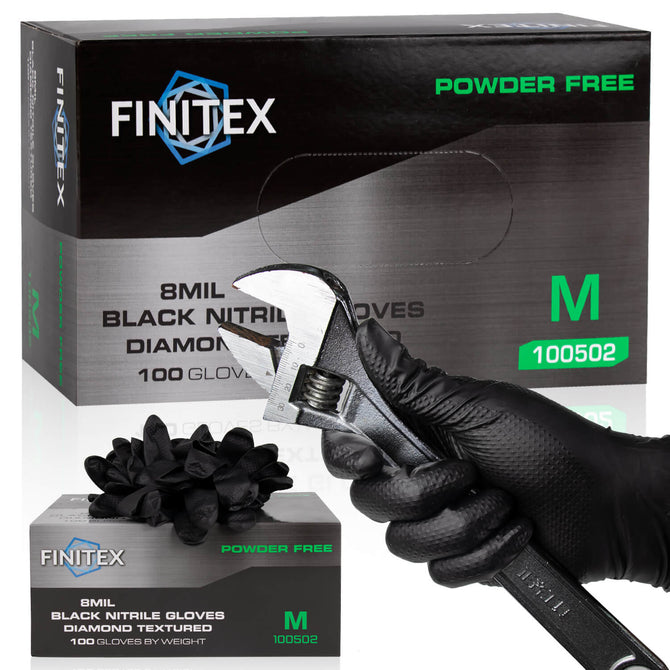

If you work in an industry that involves greasy tools—whether that is automotive repair, heavy equipment maintenance, or even commercial fishing—you know the frustration of slippery hands. You might find yourself squeezing a screwdriver tighter than necessary or dropping a bolt at the worst possible moment.
When it comes to maintaining dexterity and control in oily environments, the debate usually comes down to one specific feature: the texture.
So, let us settle this. When you are elbow-deep in grease, should you reach for a diamond-textured glove or a smooth one?
The Science of Slipping
First, let’s talk about why smooth gloves fail us in greasy conditions. Standard smooth nitrile gloves are great for medical settings or food prep because they offer a sterile, bare-hand feel. However, the moment they come into contact with petroleum-based oils or grease, the surface tension changes.
Without a texture to break the seal of the lubricant, the glove essentially hydroplanes over the surface of your tools. You lose mechanical friction, which forces your hand muscles to work harder to maintain a grip. This leads to hand fatigue and, eventually, an accident.
The Diamond Texture Advantage
This is where the raised diamond texture comes into play. Unlike smooth gloves, a diamond-textured surface creates thousands of microscopic channels across the palm and fingers .
Here is what happens when you put them to work:
-
Fluid Redirection: When you grab a greasy wrench, the oil has nowhere to go on a smooth surface. On a textured glove, the raised diamond pattern displaces the fluid into the channels, allowing the high points of the texture to maintain direct contact with the tool .
-
Increased Surface Area: Think of it like a tire tread. The pattern increases the friction coefficient without requiring you to death-grip the handle.
-
Confidence in Motion: Users frequently report that textured gloves allow for a more relaxed grip, which is essential for precision work like lining up bolts or handling small parts .
The "Clean Wipe" Trade-off
However, no glove is perfect. Experienced mechanics note one specific drawback to the diamond texture: cleanup.
If you are the type of person who wipes your gloves down with a rag to check your work or grab a clean part, the texture can hold onto grime. As one veteran user pointed out, the texture is great for grip but can make it "more challenging to wipe grease or gasket goo from the gloves when you want to keep using them" .
So, if you are doing detailed cleaning of parts and constantly wiping your hands, you might find yourself going through gloves slightly faster. But for raw gripping power in messy situations? Texture wins every time.
Thickness Matters: Why 8 Mil is the Sweet Spot
When choosing a glove for greasy tools, texture is only half the battle. If the glove is too thin (think 3 or 4 mil), it will tear the second you encounter a sharp edge on a greasy engine block. If it is too thick, you lose the tactile feedback needed to feel what you are doing.
In my experience, 8 mil is the goldilocks zone for industrial work . It provides enough puncture resistance to handle sharp tools and metal burrs, while remaining flexible enough to let your hands breathe and move.
Our Go-To Recommendation
At our store, we prioritize gear that holds up to real-world abuse. When customers ask me for a glove that can handle a Saturday oil change or a week of professional contracting work, I point them toward heavy-duty options with a proven track record.
For those dealing with greasy tools day in and day out, we highly recommend the FINITEX 8 Mil Diamond Textured Black Industrial Nitrile Gloves.
These gloves check all the boxes for the gritty work we have discussed:
-
Tactical Grip: The 3D diamond texture is aggressive enough to grab oily pliers but subtle enough to handle small fasteners .
-
Heavy-Duty Build: At 8 mils, they stand up to abrasion and punctures without feeling like cardboard .
-
Industrial Grade: They are designed to resist the chemicals and greases that break down lesser gloves .
-
Latex-Free: No worries about allergic reactions during long jobs.
The Final Verdict
If you are working with dry parts or in a clean environment, a smooth glove might offer the maximum sensitivity. But if your work involves grease, oil, or lubricants of any kind, you need a diamond texture.
It is a simple upgrade that reduces hand fatigue, increases safety, and keeps you focused on the job instead of your grip.