

A disposable glove can look perfectly fine in the box and still fail when the job gets demanding.
Maybe you're repairing a transmission, tattooing a client, cleaning a commercial kitchen, or preparing food for a busy shift. Then, without warning—snap. The glove tears.
A torn glove is more than an inconvenience. It can interrupt the job, increase glove consumption, and reduce the level of protection you expect from disposable PPE.
With so many disposable nitrile gloves on the market, comparing products based only on price can be difficult. Two boxes may look similar on the shelf while performing very differently in actual use.
The good news is that you don't need a laboratory to spot some common signs of poor-quality gloves.
Here are five practical ways to evaluate nitrile glove quality before you commit to a large order.
1. Check How the Gloves Dispense
Quality starts before the glove even reaches your hand.
Open a new box and pull out several gloves. Pay attention to how easily they separate from one another and whether they maintain a consistent shape.
What to Look For
Easy dispensing:
A well-packed glove should come out individually without repeatedly pulling several gloves from the box at once.
Consistent appearance:
Look at the fingers, palm, and cuff. The gloves should have a reasonably consistent color, shape, and finish throughout the box.
Obvious defects:
Watch for tears, holes, excessive sticking, irregular edges, or areas that look unusually thin.
If several gloves repeatedly come out together or the material feels unusually tacky, it may be worth checking the product's packaging, storage conditions, and manufacturing quality.
Why Does This Matter?
Poor dispensing creates unnecessary waste. If employees routinely pull out two or three gloves when they only need one, your actual cost per use increases.
For high-volume workplaces, small amounts of waste can add up quickly.
The FINITEX Approach
FINITEX nitrile gloves are designed and packaged with consistent dispensing in mind, helping users get the glove they need without unnecessary waste.
For businesses that go through gloves by the case, packaging efficiency is a small detail that can make a noticeable difference over time.
2. Test Stretch and Elasticity
One of the easiest ways to get a feel for nitrile glove quality is to examine how the material stretches.
Nitrile gloves need to be flexible enough for everyday hand movements while maintaining their shape and integrity during use.
How to Perform a Basic Stretch Check
Take a glove and gently stretch the material between the fingers and cuff.
Pay attention to how it feels.
A good-quality glove should feel flexible rather than unusually stiff or brittle. When stretched within its intended range, the material should maintain its integrity instead of immediately splitting or tearing.
It should also recover reasonably well after the tension is released.
What Is a Red Flag?
Be cautious if a glove:
-
Tears with very little force
-
Feels unusually stiff
-
Develops cracks when stretched
-
Loses its shape easily
-
Feels excessively thin for its stated specification
These signs may indicate that the glove is not well suited to the application.
What About Tensile Strength?
Tensile strength measures how much force a material can withstand before breaking. Elongation measures how much it can stretch before breaking.
These are important performance characteristics, but they cannot be accurately determined by simply pulling a glove by hand.
For serious quality control, ask the manufacturer or supplier for product specifications and test data rather than relying solely on an informal stretch test.
3. Check for Pinholes and Visible Defects
A glove can look normal and still contain a small defect.
This is particularly important when disposable gloves are being used for applications where barrier integrity matters.
A Simple Visual Inspection
Before putting on a glove, check the:
-
Fingertips
-
Finger seams
-
Palm
-
Between the fingers
-
Cuff
-
Areas that appear unusually thin
Hold the glove up to a light source if appropriate and look for obvious holes, tears, or irregularities.
You can also gently inflate a glove for a basic visual check, provided this is appropriate for your workplace and the glove is not being used afterward.
If air visibly escapes from a hole or damaged area, discard the glove.
What Is AQL?
This is where professional quality control becomes more important.
AQL, or Acceptable Quality Limit, is a statistical sampling standard used in manufacturing quality inspection. It is not the same thing as saying that every glove in a box has a specific maximum number of defects.
For example, an AQL 1.5 specification is commonly associated with examination gloves and represents a more stringent sampling requirement than AQL 4.0 under the applicable inspection system.
However, AQL should not be interpreted as a guarantee that an individual box contains zero defects.
When purchasing gloves for medical, dental, tattoo, laboratory, or other professional applications, ask suppliers about:
-
AQL specification
-
Applicable testing standards
-
Quality-control procedures
-
Product certifications or documentation
-
Batch or lot traceability
FINITEX Quality Control
FINITEX offers medical exam grade nitrile gloves manufactured to meet applicable quality requirements, including products specified at AQL 1.5.
For buyers purchasing gloves in bulk, having documented specifications is much more useful than judging quality from appearance alone.
4. Pay Attention to Odor—but Don't Judge Quality by Smell Alone
Open a fresh box of gloves and take note of any unusually strong odor.
A mild manufacturing or rubber-like smell can occur with disposable gloves and does not automatically mean the product is defective.
However, a strong, persistent, or unpleasant chemical odor is worth investigating.
Glove manufacturing can involve multiple processing steps, including washing and surface treatment. Residual processing substances, packaging conditions, or storage environments can affect odor.
For salon professionals, glove selection can also depend on exposure to hair color, bleach, and other chemical products. If you work in a salon or beauty setting, our guide to nitrile gloves for hair dyeing covers the key factors to consider when choosing gloves for hair coloring services.
Why Does Odor Matter?
Workers may wear disposable gloves for hours at a time. An unpleasant odor can make the work environment less comfortable, particularly in enclosed spaces.
If workers experience skin irritation or discomfort while wearing a particular glove, stop using the product and investigate the cause rather than assuming that odor alone proves the glove is unsafe.
It's also important to remember that odor is not a reliable standalone test of glove quality.
A better evaluation combines odor with material condition, product specifications, manufacturing documentation, and actual performance.
5. Check the Glove's Thickness, Weight, and Specifications
The final step is to look beyond the marketing language on the box.
Terms such as “heavy duty,” “premium,” and “industrial strength” can mean different things from one supplier to another.
Instead of relying on these descriptions, check the actual product specifications.
Compare Thickness
Glove thickness is commonly measured in mil, with thicker gloves generally providing more material and potentially greater durability for demanding applications.
For example:
-
Around 3 mil: commonly used for lighter-duty applications where dexterity is important
-
Around 4–5 mil: a balance between flexibility and durability
-
6 mil and above: often selected for more demanding industrial or heavy-duty applications
These are general guidelines, not guarantees of performance. Glove formulation, design, manufacturing quality, and the specific application all matter.
Don't Use Weight as a Universal Thickness Test
Glove weight can be useful when comparing products, but it should not be treated as a universal conversion between weight and thickness.
A glove's weight can vary depending on:
-
Glove size
-
Glove length
-
Thickness
-
Material formulation
-
Cuff design
-
Overall glove dimensions
For example, comparing the weight of a size M glove with a size XL glove will not give you a meaningful quality comparison.
If you are evaluating suppliers, compare the same size and product specifications whenever possible.
Check the Manufacturer's Specifications
For bulk buyers, ask for documentation showing the product's:
-
Thickness
-
Weight per glove or per specified unit
-
Tensile strength
-
Elongation
-
AQL, where applicable
-
Material
-
Intended use
-
Applicable standards and certifications
This gives you a much clearer picture of what you're actually buying.
Why FINITEX Uses Different Glove Thicknesses
Different jobs require different levels of protection, flexibility, and grip.
For example, a thinner exam-grade glove may be a better fit for tasks that require precision and frequent hand movement.
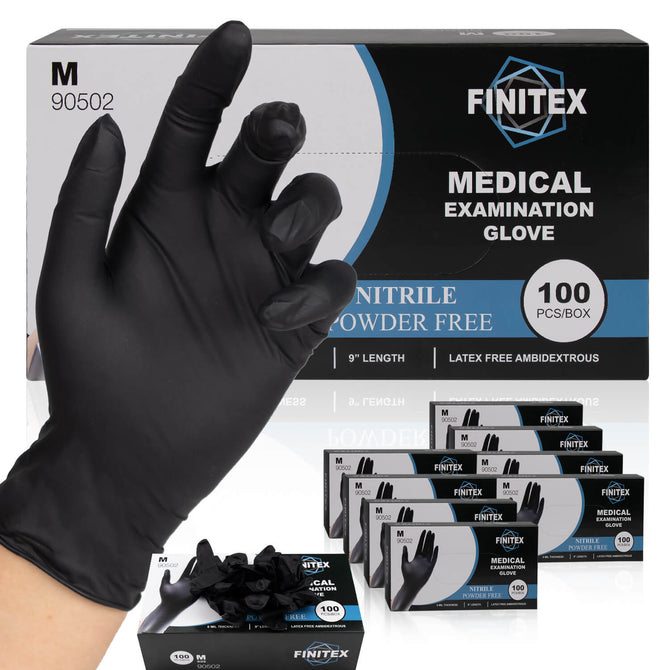
The FINITEX Blue 3.2 Mil Exam-Grade Nitrile Gloves are designed for applications where flexibility and dexterity are important, making them one option for lighter-duty professional tasks.
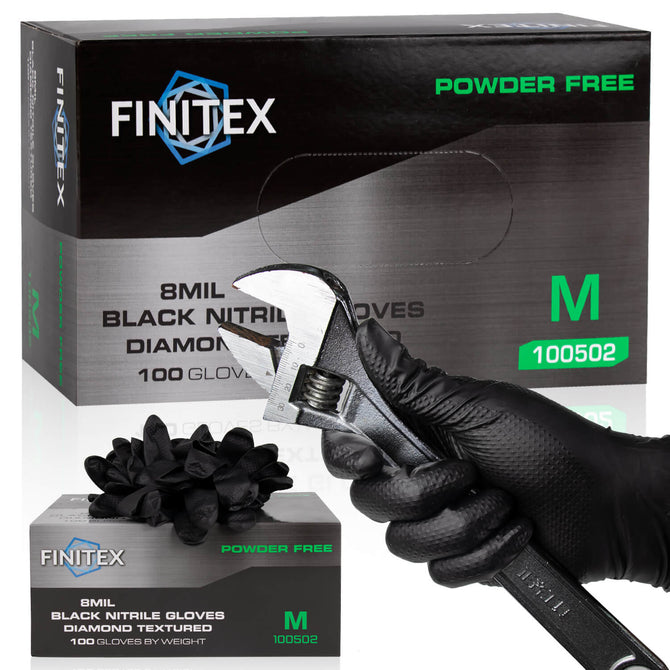
For demanding work, thicker gloves can provide additional material and durability. The FINITEX 8 Mil Diamond Textured Black Industrial Nitrile Gloves are designed for heavy-duty applications where thickness and grip are important considerations.
This difference is why businesses should select industrial nitrile gloves based on the actual work environment rather than simply choosing the thickest glove available.
FINITEX offers nitrile gloves in different thicknesses, colors, and surface textures so businesses can choose products based on the demands of the job.
Price Isn't the Same as Value
When purchasing nitrile gloves by the case, it's easy to focus on the price printed on the quote.
But price per box isn't the same as cost per use.
Consider a simple example.
Option A: Lower-Priced Gloves
-
$5 per box
-
Frequent tearing
-
Employees use 2–3 pairs during one task
-
More interruptions
-
Higher glove consumption
Option B: Higher-Quality Gloves
-
$7 per box
-
Better suited to the application
-
One pair may last through the task
-
Less frequent replacement
-
Lower waste
The second product costs more per box but may cost less over the course of a month.
That's why procurement teams should look beyond price per box and consider:
Cost per use = Total glove cost ÷ Number of useful uses
For high-volume businesses, this is often a more meaningful metric than the initial purchase price.
A Quick Nitrile Glove Quality Checklist
Before placing a large order, run through this checklist:
☐ Gloves dispense individually
☐ Color and appearance are reasonably consistent
☐ No obvious holes, tears, or defects
☐ Material feels flexible rather than brittle
☐ Gloves perform appropriately for the intended application
☐ Thickness matches the stated specification
☐ Product weight is consistent when comparing the same size and specification
☐ AQL information is available where applicable
☐ Tensile strength and elongation data are available when needed
☐ Product standards and certifications can be verified
☐ Packaging and storage conditions are appropriate
If a supplier cannot provide basic product specifications or quality documentation, that's a reason to ask more questions before placing a large order.
Final Takeaway
The best way to evaluate high-quality nitrile gloves is not to rely on one simple test.
Look at the whole picture: dispensing, material flexibility, visible defects, odor, thickness, specifications, quality documentation, and—most importantly—how the glove performs in the job it's designed for.
For businesses purchasing disposable gloves in bulk, a few extra dollars per case can be insignificant compared with the cost of frequent glove failures, wasted product, and interrupted work.
Whether you're buying gloves for a dental office, tattoo studio, salon, cleaning company, automotive shop, food-service operation, or industrial workplace, choose the glove based on performance, specifications, and cost per use—not just the lowest price on the quote.
Explore the FINITEX Nitrile Gloves collection to compare different thicknesses and glove types for your application.